Four Pillars of Destiny Explained: A Beginner's Guide
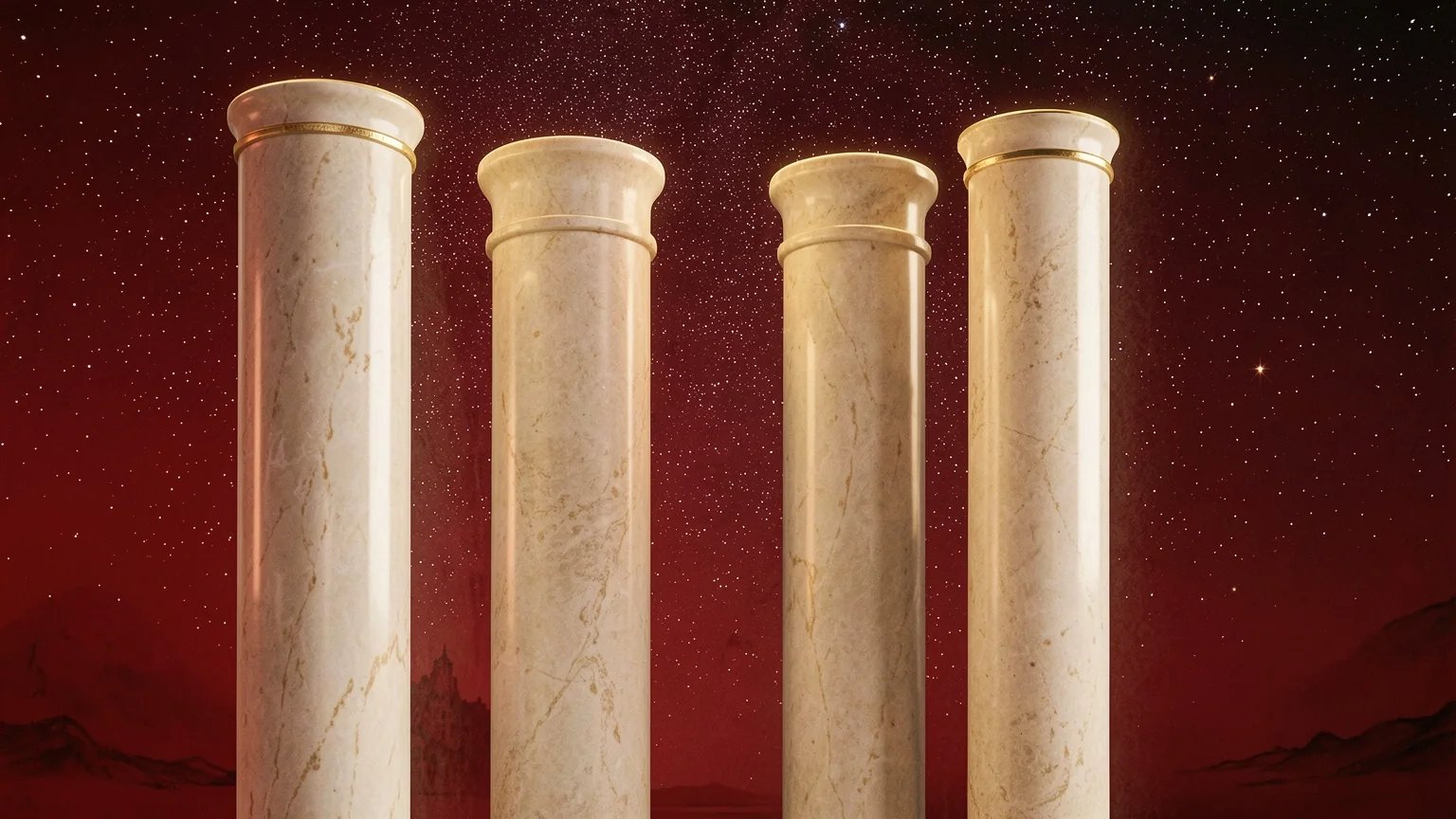
If you have ever had a fortune teller reading and wondered what was really going on behind it, the four pillars of destiny is very often the answer. It is the traditional Chinese system that turns a person's birth year, month, day and hour into a chart of eight characters, and it has been read for centuries as a way to understand temperament, strengths and the timing of a life.
This beginner's guide explains what the four pillars of destiny actually is, where it came from, what the eight characters mean, how the system differs from a Western birth chart, and the order in which a chart is usually read. Everything here is a cultural reference, presented for understanding rather than as a fixed verdict.
What are the four pillars of destiny?
The four pillars of destiny is a Chinese system of character reading built from the traditional calendar. It arranges the year, month, day and hour of a birth into four columns, which is where the name comes from: four pillars, standing side by side, each made of two characters.
Each pillar pairs one heavenly stem with one earthly branch. Because there are four pillars and each holds two characters, the finished chart contains eight characters in total. That is why the same system is also called an eight-character chart, and why the everyday name in Chinese is simply "eight characters."
The four pillars each carry a traditional meaning. The year pillar is read for family background and the early environment. The month pillar is read for upbringing and working style. The day stem is read as the person's core self. The hour pillar is read for later years and how the person reaches outward into the world. Read together, the four pillars of destiny describe a person as a whole rather than as a single fixed trait.
This framework is the foundation of much of traditional Chinese astrology. When a Chinese fortune teller sketches a chart from your birth details, the four pillars of destiny is the skeleton they are drawing, and everything else — the elements, the roles, the luck cycles — hangs from that skeleton.
A short history: from a calendar to a system of character
The four pillars of destiny grew out of a calendar, not a prophecy. Ancient China marked years, and later days, using pairs of heavenly stems and earthly branches that cycle through sixty combinations. This sixty-cycle calendar is one of the oldest continuous dating systems in the world, and it is still used alongside the familiar solar calendar today.
The earliest written uses of the stem-and-branch system are records of time, not fortune. The classical history Records of the Grand Historian, in its "Chapter on Money-makers," uses the cycle to date events and describe the rise and fall of wealth across generations — a reminder that the system began as an orderly way to mark time before it became a tool for reading character.
The turning point came over a long span, as scholars began to ask whether a person's birth moment, expressed in the same calendar language, might say something about that person. By the Tang and Song dynasties, the practice we now call the four pillars of destiny had matured into the form that is broadly taught today, with the day stem at the center and the other characters read in relation to it.
The key point for a modern reader is that the four pillars of destiny is a cultural and historical system, not a supernatural one. It is a structured way of describing tendencies and timing using a calendar vocabulary, and its authority rests on centuries of accumulated interpretation rather than on any single text or any one teacher. That long history is also why it reads as a system of ideas you can study, rather than a set of secrets you must simply accept on someone's word.
The eight characters, explained simply
To read the four pillars of destiny, you do not need to memorize anything, but it helps to know what the pieces are called.
The heavenly stems (天干) are ten characters. The earthly branches (地支) are twelve characters, and they are the ones that carry the familiar zodiac animals. A stem and a branch pair up to form one pillar, and because ten and twelve do not divide evenly, the combinations cycle through sixty unique pairs before repeating.
The day stem of the chart is called the day master (日主), and it represents the person at the center of the reading. Every other character is then described in relation to the day master, which is the single most important idea in the whole system.
From there, two more layers are added. The five elements (五行) — wood, fire, earth, metal and water — describe the qualities of each character and the balance of the chart as a whole. The ten gods (十神) classify the other characters relative to the day master, using roles such as the direct officer, the indirect wealth and the eating god.
Finally, the chart is placed in time through luck cycles. These move in roughly ten-year steps, with yearly cycles layered on top, and they describe how the balance of the chart shifts as a person ages. The phrase "four pillars" (四柱) itself simply names the four columns; everything else is the reading that happens around them.
One thing that often surprises Western readers is how small a role the zodiac animal actually plays. The animal is the earthly branch of the year pillar — one of eight characters. Two people born in the same "year of the horse" can have very different charts because their month, day and hour pillars differ, and those differences matter more than the shared animal. The zodiac sign is the door into the system, not the whole building.
How to read a four pillars chart in order
A beginner should read a four pillars of destiny chart in a fixed order, from the center outward, rather than hunting for a single verdict.
First, identify the day master. Because everything else is described relative to this one character, you cannot usefully read anything until you know which character it is.
Second, survey the balance of the five elements. Count which elements appear often and which are scarce. The traditional view is less concerned with one element being "good" than with whether the whole chart is balanced, and with what the coming decades do to that balance.
Third, read the four pillars as a life sequence. The year and month pillars describe origins and working style, the day pillar describes the self, and the hour pillar describes later years and outward direction. Reading them in that order turns eight abstract characters into a rough narrative of a life.
Fourth, look at the luck cycles. The current ten-year cycle sets the general climate, and the current year adds the weather. When a person stands near the boundary between two cycles, the transition is traditionally read as a period when life tends to rearrange itself.
The discipline of this order is part of the tradition's value. It keeps a reader from seizing on one striking character and ignoring the whole, which is the most common beginner's mistake.
Is the four pillars of destiny fortune telling?
In the broadest sense, yes — it belongs to the same family as a fortune teller reading, and it shares that world's vocabulary of charts, elements and favorable timing. But it is useful to be precise about what kind of reading it is.
The four pillars of destiny is not a crystal-ball act. It does not claim to see winning lottery numbers or to read a stranger's secret thoughts. What it does is structured and repeatable: the same birth details always produce the same eight characters, and the same chart is read with the same vocabulary of day master, elements, ten gods and luck cycles.
That structure is what separates a four pillars chart from a casual horoscope or a one-line fortune. A fortune teller might give you a memorable sentence; a four pillars of destiny reading gives you a map you can return to and study, and its value grows as you learn the vocabulary yourself.
This is also why the system survives so well in the internet age. A chart can be generated by a free bazi calculator in seconds, and the educational side of the four pillars of destiny — the meanings of the pillars, the elements and the cycles — can be learned at any pace, without secrecy or initiation.
What the four pillars of destiny can and cannot tell you. Honest writing about the four pillars of destiny should state its limits as clearly as its strengths.
What the system is good at is describing tendency and timing: a person's natural temperament, the kind of environment they were born into, the working style they tend toward, and the seasons of a life as they unfold across decades. These are broad strokes, but they are broad strokes that many people find remarkably recognizable.
What the system cannot do is guarantee outcomes. No chart determines your fate, and no responsible reading presents it that way. Traditional Chinese astrology treats the four pillars as a map of weather, not a chain. The chart may suggest that a certain decade favors expansion or caution, but it does not remove your choices, your effort or your responsibility.
It also cannot replace professional advice in matters of health, finance or law. A chart is a cultural lens for self-reflection, not medical, investment or legal counsel. Keeping that boundary clear is part of respecting the tradition rather than overselling it.
Used with those limits in mind, the four pillars of destiny earns its place as one of the world's oldest and most fully developed systems of character reading. It rewards the reader who treats it as a tool for understanding rather than a source of certainty. To explore the tradition's question-driven cousins, see our Da Liu Ren guide and our Qi Men Dun Jia guide.
Four pillars of destiny vs a Western birth chart
People who know Western astrology often ask how the four pillars of destiny compares to a birth chart. The two systems share a starting point — a moment of birth — but they describe it with completely different tools.
A Western birth chart plots the positions of the planets against the zodiac at the birth moment, and reads personality and transits from those placements. A four pillars chart ignores the planets entirely and instead expresses the birth moment in the stem-and-branch calendar, then reads the balance of elements, the roles of the ten gods and the arc of the luck cycles. This difference in raw material is the single most useful thing to know when you move between the two systems.
The result is a difference in emphasis. Western astrology tends to describe a person's fixed character in rich detail. The four pillars of destiny tends to describe a person as a moving balance — how their natural elements interact, and how that balance behaves across decades of luck cycles. One is a photograph; the other is closer to a weather forecast across a lifetime.
Neither system is "more accurate" in any provable sense. They are two cultural vocabularies for the same human instinct: to look for pattern and meaning in the moment we entered the world. Many people enjoy reading both, and many find that the four pillars of destiny answers a question Western charts do not ask, which is what will happen next, and when. Reading both is not a contradiction; it is simply two windows onto the same birth moment.
Ready to see the system applied to your own birth details? Open the free bazi calculator to build your four pillars chart, and read it in the order described here — day master first, then elements, then the pillars as a life sequence, then the luck cycles. The chart costs nothing to generate, and it is a genuinely rewarding first step into one of the world's most enduring systems of self-understanding.